POTS
THE hidden WAY car emissions CAN KILL YOU.
Traffic pollution invades your home—triggering respiratory distress often mistaken for bad indoor air or asthma, while hidden toxins silently block your body’s smallest blood vessels.
Children are among those particularly vulnerable to traffic-related air pollution.

ATP
ATP is the primary energy molecule used by cells. Nearly all cellular functions — including muscle activity, nerve signaling, and repair processes — depend on ATP availability.
Carbon monoxide (CO)
Carbon monoxide is a gas that binds strongly to hemoglobin and interferes with oxygen transport. Even low-level exposure can reduce oxygen delivery to tissues and increase physiological stress.
Cellular energy production
Cellular energy production refers to the processes cells use to generate ATP. Under normal conditions, this mainly occurs through oxygen-dependent mitochondrial respiration.
Chronic hypoxia
Chronic hypoxia means tissues experience long-term reduced oxygen availability. This can force the body into continuous compensatory stress responses and altered metabolism.
Circulation
Circulation is the movement of blood through the body. It delivers oxygen and nutrients to tissues while removing carbon dioxide and waste products.
Compensatory mechanism
A compensatory mechanism is the body’s attempt to maintain stability during dysfunction or stress. These responses may help temporarily, but chronic compensation can eventually contribute to symptoms.
Dysautonomia
Dysautonomia refers to dysfunction of the autonomic nervous system. It can affect heart rate, blood pressure, circulation, digestion, temperature regulation, and stress responses.
Endothelial dysfunction
Endothelial dysfunction means the inner lining of blood vessels no longer regulates circulation normally. This can impair blood flow control, oxygen delivery, vascular relaxation, and microcirculation.
Endothelium
The endothelium is the thin inner lining of blood vessels. It plays a central role in regulating blood flow, vascular tone, inflammation, and oxygen delivery.
Energy deficit
An energy deficit occurs when cells cannot produce enough ATP to meet demand. This can contribute to fatigue, reduced physical capacity, impaired recovery, and physiological stress.
Glycolysis
Glycolysis is a form of energy production that does not require oxygen. It is less efficient than mitochondrial respiration and produces lactate as a byproduct.
Hypoxia
Hypoxia means insufficient oxygen availability at the tissue level. Even when blood oxygen appears normal, impaired circulation can still create localized hypoxia.
Insulin resistance
Insulin resistance occurs when cells respond poorly to insulin signaling. This disrupts glucose regulation and is commonly associated with metabolic dysfunction.
Lactic acid
Lactic acid is produced when cells rely more heavily on glycolysis for energy production. Increased lactic acid production can occur during hypoxia or impaired oxygen utilization.
Lactate
Lactate is a metabolic byproduct generated during glycolysis. Elevated lactate levels may indicate increased reliance on anaerobic energy production.
Metabolic dysfunction
Metabolic dysfunction refers to impaired regulation of energy production and cellular metabolism. It can affect glucose handling, mitochondrial function, circulation, and stress physiology.
Metabolism
Metabolism includes all chemical processes required to maintain cellular function and energy production. It involves how the body uses oxygen, nutrients, and energy.
Microcirculation
Microcirculation refers to blood flow through the body’s smallest vessels, including capillaries. This system is critical for oxygen delivery directly to tissues.
Microvascular dysfunction
Microvascular dysfunction means small blood vessels no longer regulate blood flow properly. This can create uneven oxygen delivery and localized tissue stress.
Mitochondria
Mitochondria are structures inside cells responsible for most ATP production. They generate energy primarily through oxygen-dependent metabolism.
Nitric oxide (NO)
Nitric oxide is a signaling molecule that helps blood vessels relax and regulate circulation. Reduced nitric oxide activity can contribute to vascular dysfunction and impaired blood flow.
Oxidative phosphorylation
Oxidative phosphorylation is the mitochondria’s primary oxygen-dependent energy production pathway. It produces large amounts of ATP under normal physiological conditions.
Oxidative stress
Oxidative stress occurs when reactive oxygen species exceed the body’s antioxidant defenses. Excess oxidative stress can damage cells, blood vessels, and cellular signaling systems.
Oxygen delivery
Oxygen delivery refers to the transport of oxygen from the lungs to tissues. This depends on blood flow, hemoglobin function, vascular regulation, and microcirculation.
Parasympathetic nervous system
The parasympathetic nervous system supports recovery, repair, digestion, and energy conservation. It is often described as the body’s “rest and recovery” system.
Perfusion
Perfusion refers to blood flow reaching tissues and organs. Reduced perfusion can impair oxygen and nutrient delivery even when circulation is still present.
Physiological stress
Physiological stress refers to biological strain placed on the body. This can result from impaired oxygen delivery, metabolic imbalance, inflammation, or chronic compensation.
Redox balance
Redox balance refers to the balance between oxidation and antioxidant defense systems. Disruption of redox balance can contribute to oxidative stress and cellular dysfunction.
Sympathetic nervous system
The sympathetic nervous system activates the body’s stress response. It increases heart rate, blood pressure, alertness, and circulatory compensation during physiological stress.
Tissue hypoxia
Tissue hypoxia means specific tissues are not receiving sufficient oxygen. This may occur even when standard oxygen measurements appear normal.
Vasoconstriction
Vasoconstriction means blood vessels narrow. This can reduce blood flow to tissues and increase circulatory resistance.
Vasodilation
Vasodilation means blood vessels relax and widen. This improves blood flow, oxygen delivery, and tissue perfusion.
The information provided here is for educational purposes only and is not intended as medical advice. Some content discusses hypotheses and proposed biological mechanisms based on an integration of published research. It should not be used to diagnose, treat, cure, or prevent any medical condition. Use this information as a starting point for discussion with a qualified healthcare provider before making decisions about medications, supplements, devices, or changes to your health regimen. See full disclaimer and ai disclosure.
Example of Systemic Dysfunction
Hypothesis
POTS – When Fibrin amyloids Reduce Oxygen Delivery and Prevent Energy Recovery
Fibrin amyloids have been proposed to significantly contribute to POTS symptoms associated with Long COVID and potentially other syndromes (Kell et al., 2024).
Fibrin amyloids restrict microvascular oxygen delivery, reducing aerobic ATP production and slowing the restoration of cellular energy stores. Ordinary activities can therefore consume ATP and phosphocreatine faster than they can be regenerated. When new activity begins before recovery is complete, the energy deficit accumulates and symptoms may continue to worsen for hours after the activity has ended.
Standing Increases the Demand on an Already Oxygen-Limited Circulation
When a person stands up, gravity naturally pulls blood downward. In a healthy body, vascular constriction, the skeletal-muscle pump, and venous valves help maintain blood return to the heart and sufficient oxygen delivery to tissues.
If persistent Fibrin amyloids already obstruct the microcirculation, oxygen delivery is limited before the person even stands. Moving upright adds a new circulatory demand to a system that is already operating with reduced tissue oxygen availability.
Blood Pooling Further Reduces an Already Limited Oxygen Supply
When transitioning to an upright position, blood pooling in the lower body reduces venous return and stroke volume. At the same time, Fibrin amyloids continue to restrict red-blood-cell passage through the smallest vessels.
The combined effect is a further reduction in oxygen delivery to tissues and the brain.The autonomic nervous system attempts to compensate by increasing heart rate and vascular tone to maintain cardiac output and cerebral circulation.
Standing Uses Energy Faster Than It Can Be Restored
Cells continuously use ATP and must continuously regenerate it. Efficient ATP regeneration depends on sufficient oxygen reaching the tissues and being available for aerobic energy production. When Fibrin amyloids restrict oxygen delivery, ATP cannot be restored as efficiently as it is being consumed. Standing increases energy demand at the same time that oxygen availability remains limited.
Microvascular obstruction → reduced oxygen delivery → impaired ATP regeneration → standing increases ATP demand → available energy falls faster than it can be restored
As long as the person remains upright, the energy deficit can continue to deepen because the cells cannot adequately replenish what they are using.
The Energy Reserve Can Collapse While Upright
The resulting problem is not simply that standing “uses more energy.” The body is trying to maintain circulation, blood pressure, cerebral oxygen delivery, and basic cellular function while the oxygen required to continuously restore cellular energy remains insufficient.
The longer the person remains upright, the greater the mismatch can become between energy being consumed and energy being regenerated. This can eventually produce a functional collapse in which sitting or standing becomes increasingly difficult until the circulatory and energy demand is reduced again.

Why Tachycardia Fails to Fix the Problem
Faster Heart Rate Does Not Guarantee Oxygen Delivery
In POTS, the heart can beat at 120 beats per minute simply while washing dishes in the kitchen. One might assume that this rapid heart rate would pump blood and oxygen into tissues efficiently, but this does not happen.
Microvascular Barriers Prevent Tissue Oxygenation
If there is a functional barrier within the capillaries and microcirculation—such as persistent Fibrin amyloids, localized vasospasm, or abnormal flow patterns—A higher heart rate does not correct impaired microvascular flow. Blood flow can remain uneven, and some tissue regions continue to receive too little oxygen despite maintained pressure in the larger vessels.
The Tachycardia Paradox: The heart works overtime consuming myocardial energy, but blood shunts past critical tissue zones due to microvascular barriers.
The Heart Compensates But The Problem Remains
The rapid heart rate in POTS represents an emergency compensatory response. The heart performs additional work and consumes more energy, yet tissue oxygen availability remains limited when the underlying microvascular obstruction persists.
Fibrin amyloids > The Forced Shift to Glycolysis
Oxygen Shortage Forces a Survival Shift
When fibrinaloid structures restrict oxygen delivery, the cells rely more heavily on glycolysis, producing energy from glucose in the cytoplasm. However, glycolysis is highly inefficient—producing a mere 2 ATP energy molecules per glucose molecule, whereas the optimal mitochondrial pathway would yield over 30 ATP molecules. The cell is left in a state of continuous, relative energy starvation, and lactate production increases while hydrogen ions accumulate, contributing to local tissue acidification.
Standing Rapidly Increases Energy Demand
When a POTS patient stands up, the dynamic physical load causes cellular energy and oxygen demands to skyrocket. Inefficient glycolysis can no longer cover this sudden energy crisis, increasing reliance on phosphocreatine as a rapid energy buffer.
The system desperately attempts to generate immediate energy and fill the deficit left by glycolysis by transferring phosphate groups from creatine directly to reform ATP. It tries to initiate its internal recovery and recharging mechanism—the creatine phosphate shuttle—to rapidly produce the missing energy.
The Oxygen Lock Prevents Energy Recovery
This is where the cellular catastrophe occurs: persistent microclots and microvascular barriers severely impair oxygen delivery to the tissues. For the phosphocreatine system to restore depleted energy reserves, it depends entirely on aerobic ATP production inside the mitochondria.
When oxygen delivery becomes insufficient, ATP production slows and phosphocreatine stores cannot recharge normally. Phosphocreatine attempts to perform its role, but it runs directly into an oxygen lock created by impaired oxygen delivery. The system cannot generate energy out of thin air without oxygen.
Spectroscopy shows that cellular energy stores cannot recharge without continuous mitochondrial oxygen availability.
Phosphocreatine recovery after exertion is abnormally delayed. This delay appears to persist over time rather than normalize spontaneously, suggesting that the underlying problem remains present as long as oxygen delivery remains impaired.
The problem appears to be systemic rather than limited to skeletal muscle, since delayed phosphocreatine recovery correlates directly with reduced myocardial energy reserves as well.
Phosphocreatine recovery depends entirely on oxygen availability. The mitochondria themselves remain structurally intact, but persistent microclots impair tissue oxygen delivery and prevent normal restoration of cellular energy stores.
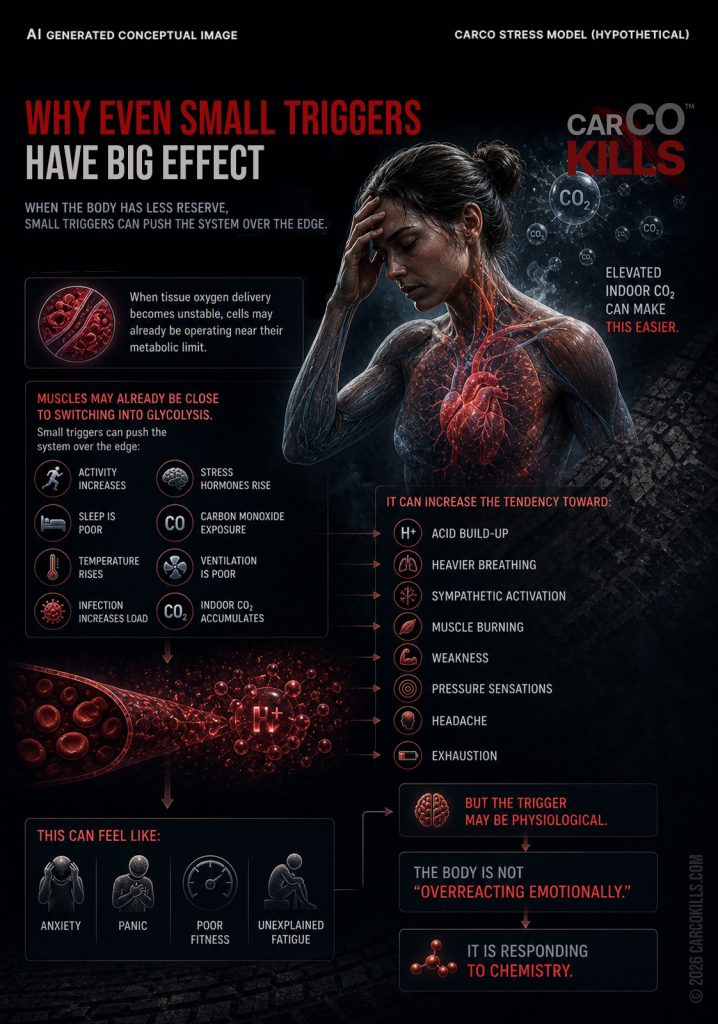
Low-level CO exposures become catastrophic
Loss of Buffering Capacity
A person already living at the absolute limit of their recovery capacity loses the ability to buffer even minor additional disruptions. The primary issue is not necessarily the absolute magnitude of the exposure itself, but the complete lack of physiological reserve. An exposure level that causes zero symptoms in a healthy person becomes highly significant when the body’s capacity for recovery is already critically limited.
These routine scenarios include sitting in heavy traffic, spending time near idling vehicles, everyday exposure to combustion products from wood-burning stoves, saunas, fireplaces, barbecues, gas stoves, gas ovens, and gas heating systems, and poorly ventilated spaces where combustion products accumulate.
Carbon Monoxide Targets Two Critical Systems
When carbon monoxide enters the system, it strikes directly at two vulnerable mechanisms. First, it binds to hemoglobin, further reducing an already compromised blood oxygen-carrying capacity. Second, it binds directly to cytochrome c oxidase within the mitochondria, completely blocking the minimal aerobic energy production that the mitochondria were still managing to sustain.
As a result, the kinetics of cellular respiration and the recovery speed of energy stores grind to a near-total halt. The system enters an acute cellular energy emergency, triggering a severe crash with an intense need for prolonged rest or sleep. Reduced activity lowers energy demand while CO clears and energy recovery gradually resumes. Sleep serves as the body’s ultimate protective mechanism—a state where energy expenditure is driven down so low that even a minimal, baseline recovery can slowly begin once the exposure subsides.
Summary
POTS and its resulting orthostatic intolerance are the direct consequence of severely slowed systemic oxygen delivery kinetics. The central problem is impaired oxygen delivery caused by persistent fibrin amyloid microclots, which progressively limit both aerobic energy production and the restoration of energy reserves.
POTS is not merely a wild, runaway heart rate; it is the body’s desperate, macro-level mechanical attempt to compensate for a micro-level lack of oxygen. It is entirely a relationship between physiological load and the body’s buffering capacity. The burden imposed by persistent microclots and impaired oxygen delivery becomes so severe that even minor dynamic changes, such as gravity, completely overwhelm the system’s ability to transport oxygen and generate energy efficiently.
Each new metabolic demand arrives before the previous recovery process has had the chance to finish. The body therefore operates not within a single, acute energy failure, but under the constant weight of an accumulating recovery deficit.
Sources
Kell, D. B., Khan, M. A., Kane, B., Lip, G. Y. H., & Pretorius, E. (2024). Possible role of fibrinaloid microclots in postural orthostatic tachycardia syndrome (POTS): Focus on long COVID. Journal of Personalized Medicine, 14(2), 170. https://www.mdpi.com/2075-4426/14/2/170
Chopoorian, A. H., Wahba, A., Celedonio, J., Nwazue, V., Smith, E. C., Garland, E. M., Paranjape, S., Okamoto, L. E., Black, B. K., Biaggioni, I., Raj, S. R., & Gamboa, A. (2021). Impaired endothelial function in patients with postural tachycardia syndrome. Hypertension, 77(3), 1001–1009. https://pmc.ncbi.nlm.nih.gov/articles/PMC7878337/
Finnigan, L. E. M., et al. (2024). 1H and 31P MR spectroscopy to assess muscle mitochondrial dysfunction in long COVID. Radiology. https://pubs.rsna.org/doi/abs/10.1148/radiol.233173
Fedorowski, A., et al. (2023). Autonomic dysfunction and postural orthostatic tachycardia syndrome in post-COVID-19 syndrome. Nature Reviews Cardiology. https://www.nature.com/articles/s41569-023-00842-w
Gunning, W. T., III, et al. (2025). Postural orthostatic tachycardia syndrome in post-COVID-19 patients. Frontiers in Medicine. https://www.frontiersin.org/journals/medicine/articles/10.3389/fmed.2025.1560120/full
Godlewska, B. R., et al. (2025). Brain and muscle chemistry in myalgic encephalomyelitis/chronic fatigue syndrome (ME/CFS) and long COVID: A 7T magnetic resonance spectroscopy study. Molecular Psychiatry. https://www.nature.com/articles/s41380-025-03108-8

site updates
The site is continuously updated.
Sources are under review, content will be added to existing topics, and more images will be brought to the site later.
NEW CONTENT COMING:
- News
– Rights to clean air