5 INFECTION AS A TRIGGER
THE hidden WAY car emissions CAN KILL YOU.
Traffic pollution invades your home—triggering respiratory distress often mistaken for bad indoor air or asthma, while hidden toxins silently block your body’s smallest blood vessels.
Children are among those particularly vulnerable to traffic-related air pollution.

ATP
ATP is the primary energy molecule used by cells. Nearly all cellular functions — including muscle activity, nerve signaling, and repair processes — depend on ATP availability.
Carbon monoxide (CO)
Carbon monoxide is a gas that binds strongly to hemoglobin and interferes with oxygen transport. Even low-level exposure can reduce oxygen delivery to tissues and increase physiological stress.
Cellular energy production
Cellular energy production refers to the processes cells use to generate ATP. Under normal conditions, this mainly occurs through oxygen-dependent mitochondrial respiration.
Chronic hypoxia
Chronic hypoxia means tissues experience long-term reduced oxygen availability. This can force the body into continuous compensatory stress responses and altered metabolism.
Circulation
Circulation is the movement of blood through the body. It delivers oxygen and nutrients to tissues while removing carbon dioxide and waste products.
Compensatory mechanism
A compensatory mechanism is the body’s attempt to maintain stability during dysfunction or stress. These responses may help temporarily, but chronic compensation can eventually contribute to symptoms.
Dysautonomia
Dysautonomia refers to dysfunction of the autonomic nervous system. It can affect heart rate, blood pressure, circulation, digestion, temperature regulation, and stress responses.
Endothelial dysfunction
Endothelial dysfunction means the inner lining of blood vessels no longer regulates circulation normally. This can impair blood flow control, oxygen delivery, vascular relaxation, and microcirculation.
Endothelium
The endothelium is the thin inner lining of blood vessels. It plays a central role in regulating blood flow, vascular tone, inflammation, and oxygen delivery.
Energy deficit
An energy deficit occurs when cells cannot produce enough ATP to meet demand. This can contribute to fatigue, reduced physical capacity, impaired recovery, and physiological stress.
Glycolysis
Glycolysis is a form of energy production that does not require oxygen. It is less efficient than mitochondrial respiration and produces lactate as a byproduct.
Hypoxia
Hypoxia means insufficient oxygen availability at the tissue level. Even when blood oxygen appears normal, impaired circulation can still create localized hypoxia.
Insulin resistance
Insulin resistance occurs when cells respond poorly to insulin signaling. This disrupts glucose regulation and is commonly associated with metabolic dysfunction.
Lactic acid
Lactic acid is produced when cells rely more heavily on glycolysis for energy production. Increased lactic acid production can occur during hypoxia or impaired oxygen utilization.
Lactate
Lactate is a metabolic byproduct generated during glycolysis. Elevated lactate levels may indicate increased reliance on anaerobic energy production.
Metabolic dysfunction
Metabolic dysfunction refers to impaired regulation of energy production and cellular metabolism. It can affect glucose handling, mitochondrial function, circulation, and stress physiology.
Metabolism
Metabolism includes all chemical processes required to maintain cellular function and energy production. It involves how the body uses oxygen, nutrients, and energy.
Microcirculation
Microcirculation refers to blood flow through the body’s smallest vessels, including capillaries. This system is critical for oxygen delivery directly to tissues.
Microvascular dysfunction
Microvascular dysfunction means small blood vessels no longer regulate blood flow properly. This can create uneven oxygen delivery and localized tissue stress.
Mitochondria
Mitochondria are structures inside cells responsible for most ATP production. They generate energy primarily through oxygen-dependent metabolism.
Nitric oxide (NO)
Nitric oxide is a signaling molecule that helps blood vessels relax and regulate circulation. Reduced nitric oxide activity can contribute to vascular dysfunction and impaired blood flow.
Oxidative phosphorylation
Oxidative phosphorylation is the mitochondria’s primary oxygen-dependent energy production pathway. It produces large amounts of ATP under normal physiological conditions.
Oxidative stress
Oxidative stress occurs when reactive oxygen species exceed the body’s antioxidant defenses. Excess oxidative stress can damage cells, blood vessels, and cellular signaling systems.
Oxygen delivery
Oxygen delivery refers to the transport of oxygen from the lungs to tissues. This depends on blood flow, hemoglobin function, vascular regulation, and microcirculation.
Parasympathetic nervous system
The parasympathetic nervous system supports recovery, repair, digestion, and energy conservation. It is often described as the body’s “rest and recovery” system.
Perfusion
Perfusion refers to blood flow reaching tissues and organs. Reduced perfusion can impair oxygen and nutrient delivery even when circulation is still present.
Physiological stress
Physiological stress refers to biological strain placed on the body. This can result from impaired oxygen delivery, metabolic imbalance, inflammation, or chronic compensation.
Redox balance
Redox balance refers to the balance between oxidation and antioxidant defense systems. Disruption of redox balance can contribute to oxidative stress and cellular dysfunction.
Sympathetic nervous system
The sympathetic nervous system activates the body’s stress response. It increases heart rate, blood pressure, alertness, and circulatory compensation during physiological stress.
Tissue hypoxia
Tissue hypoxia means specific tissues are not receiving sufficient oxygen. This may occur even when standard oxygen measurements appear normal.
Vasoconstriction
Vasoconstriction means blood vessels narrow. This can reduce blood flow to tissues and increase circulatory resistance.
Vasodilation
Vasodilation means blood vessels relax and widen. This improves blood flow, oxygen delivery, and tissue perfusion.
The information provided here is for educational purposes only and is not intended as medical advice. Some content discusses hypotheses and proposed biological mechanisms based on an integration of published research. It should not be used to diagnose, treat, cure, or prevent any medical condition. Use this information as a starting point for discussion with a qualified healthcare provider before making decisions about medications, supplements, devices, or changes to your health regimen. See full disclaimer and ai disclosure.
Infection and Massive Fibrin Amyloid formation
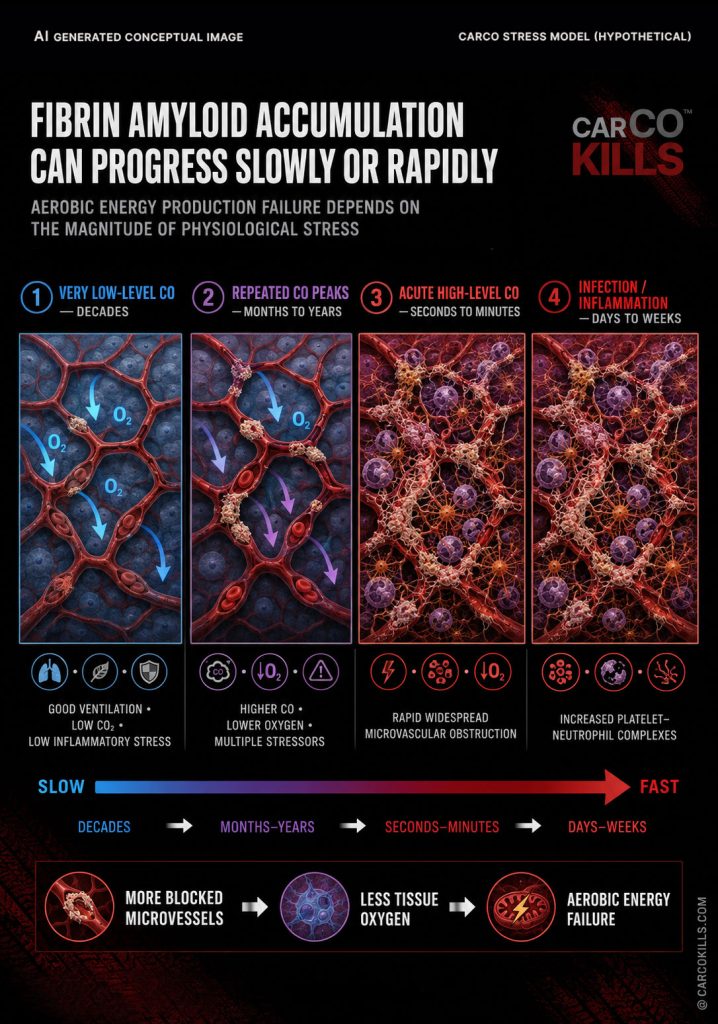
THE CARCO STRESS MODEL: Carbon Monoxide Exposure → Infection → Extensive Peroxynitrite Formation in Capillaries → Extensive Fibrin Amyloid Formation → Microvascular Obstruction → Reduced Mitochondrial Oxygen Availability → Aerobic Energy Production Failure → Rapid Systemic Dysfunctions
The Role of Neutrophils During Inflammatory Stress
During a severe infection, major injury, or surgery, neutrophil production increases several-fold. This means vastly more neutrophils are available to participate in carbon monoxide-related fibrin amyloid formation. If carbon monoxide exposure occurs during this high-neutrophil period, it may form an excessive amount of abnormal amyloid structures.
Persistence of Fibrin Amyloid Structures
Because fibrin amyloid structures resist normal physical breakdown, the structures formed during this period persist after the infection, injury, or exposure ends. These dense structures accumulate and progressively obstruct a greater number of microvessels over time.
The Sequence of System Failure
- Severe infection, major injury, or surgery increases neutrophil production.
- Overlapping carbon monoxide exposure occurs.
- Massive fibrin amyloid formation takes place.
- Microvascular obstruction increases progressively.
- Tissue oxygen delivery is severely reduced.
- System dysfunctions and organ failures occur.
An Integrated Biological Hypothesis
This complete sequence has not been directly demonstrated as a single continuous observation. It is an integrated biological hypothesis connecting several experimentally observed physical processes into one continuous mechanism.
Severe Infection and Massive Neutrophil Production
Normal Neutrophil Production
Neutrophils are the most common type of white blood cell in the human body. They form a critical physical part of the innate immune system. The human body normally produces roughly 50 to 100 billion neutrophils every day.
Neutrophil Functions in Immune Defense
Neutrophils help the immune system fight infections and heal physical injuries. These cells function as the primary defense mechanism against harmful pathogens like bacteria and fungi.
Massive Production During Severe Stress
During severe infection, major injury, or other strong inflammatory stress, neutrophil production increases several-fold. The body can increase production toward approximately one trillion neutrophils per day to manage the stress.
Prolonged Inflammatory Stages
A complicated clinical course can involve several consecutive inflammatory stages. A major injury can lead to surgery, postoperative tissue repair, and a secondary infection. Each physical stage increases and prolongs neutrophil production and activation.
Elevated Neutrophil Counts Over Time
Neutrophil counts remain approximately two to five times above control levels during the first five days of stress. Significant elevation is still physically present around day ten. Serious infections can produce similarly prolonged cellular responses.
Neutrophil Dynamics in COVID-19
In severe and critical COVID-19, longitudinal measurements show altered and increasing neutrophil counts. These elevated counts occur across approximately days 10 to 28 of illness before returning toward normal levels during convalescence.

continuous exposure during illness
Normal Interruptions in Exposure
A person normally spends much of each day outside the home at work, school, or elsewhere. If a low-level carbon monoxide source or repeated infiltration exists at home, these periods away from the building interrupt the exposure and allow blood levels to decline.
Continuous Indoor Exposure During Illness
During an infection or recovery from an injury, a person may suddenly spend almost 24 hours per day indoors for several weeks. Staying indoors increases total carbon monoxide exposure. This also reduces the physical opportunity for the gas to be cleared from the body.
Changes in Exposure Duration
The carbon monoxide source does not need to change to cause harm. What changes is the amount of time the person spends in the contaminated environment. An exposure that normally occurs part-time becomes almost continuous during the exact period when the inflammatory response is strongest.
Accumulation and Insufficient Air Exchange
A continuously operating source is not required for exposure to continue. If carbon monoxide has accumulated indoors and air exchange is insufficient, the source can stop while the gas remains in the breathing environment. Repeated releases prolong this physical accumulation further.
Relevant Exposure Patterns
Relevant carbon monoxide exposure patterns include:
- One larger exposure
- Repeated low-level exposure
- Continuous low-level exposure
A massive increase in neutrophils during an infection combined with prolonged indoor carbon monoxide exposure drives severe fibrin amyloid formation and systemic microvascular obstruction.
Sources
Lawrence, S. M., Corriden, R., & Nizet, V. (2018). The ontogeny of a neutrophil: Mechanisms of granulopoiesis and homeostasis. Microbiology and Molecular Biology Reviews, 82(1), e00057-17. https://doi.org/10.1128/MMBR.00057-17
Manz, M. G., & Boettcher, S. (2014). Emergency granulopoiesis. Nature Reviews Immunology, 14(5), 302–314. https://doi.org/10.1038/nri3660
Kalafati, L., Hatzioannou, A., Hajishengallis, G., & Chavakis, T. (2023). The role of neutrophils in trained immunity. Immunological Reviews, 314(1), 142–157. https://doi.org/10.1111/imr.13142
Finlay, L. D. B., Conway Morris, A., Deane, A. M., & Wood, A. J. T. (2021). Neutrophil kinetics and function after major trauma: A systematic review. World Journal of Critical Care Medicine, 10(5), 260–277. https://doi.org/10.5492/wjccm.v10.i5.260
Tan, Y., Zhang, W., Zhu, Z., et al. (2021). Integrating longitudinal clinical laboratory tests with targeted proteomic and transcriptomic analyses reveal the landscape of host responses in COVID-19. Cell Discovery, 7, 42. https://doi.org/10.1038/s41421-021-00274-1
Allen, R. C., & Stephens, J. T., Jr. (2011). Myeloperoxidase selectively binds and selectively kills microbes. Infection and Immunity, 79(1), 474–485. https://doi.org/10.1128/IAI.00910-09
James, P., Kaushal, D., & Wilson, R. B. (2024). NETosis in surgery: Pathophysiology, prevention, and treatment. Annals of Surgery, 279(5), 765–780. https://doi.org/10.1097/SLA.0000000000006196
Nielsen, V. G., Cohen, J. B., Malayaman, S. N., Nowak, M., & Vosseller, K. (2011). Fibrinogen is a heme-associated, carbon monoxide sensing molecule: A preliminary report. Blood Coagulation & Fibrinolysis, 22(5), 443–447. https://doi.org/10.1097/MBC.0b013e328345c069
Nielsen, V. G., Malayaman, S. N., Khan, E. S., Kirklin, J. K., & George, J. F. (2010). Carbon monoxide releasing molecule-2 increases fibrinogen-dependent coagulation kinetics but does not enhance prothrombin activity. Blood Coagulation & Fibrinolysis, 21(4), 349–353. https://doi.org/10.1097/MBC.0b013e328338948f
Machovec, K. A., Ushakumari, D. S., Welsby, I. J., & Nielsen, V. G. (2012). The procoagulant properties of purified fibrinogen concentrate are enhanced by carbon monoxide releasing molecule-2. Thrombosis Research, 129(6), 793–796. https://doi.org/10.1016/j.thromres.2011.08.005
Kell, D. B., Laubscher, G. J., & Pretorius, E. (2022). A central role for amyloid fibrin microclots in long COVID/PASC: Origins and therapeutic implications. Biochemical Journal, 479(4), 537–559. https://doi.org/10.1042/BCJ20220016
Pretorius, E., Venter, C., Laubscher, G. J., Kotze, M. J., Oladejo, S. O., Watson, L. R., Rajaratnam, K., Watson, B. W., & Kell, D. B. (2022). Prevalence of symptoms, comorbidities, fibrin amyloid microclots and platelet pathology in individuals with Long COVID/Post-Acute Sequelae of COVID-19 (PASC). Cardiovascular Diabetology, 21, 148. https://doi.org/10.1186/s12933-022-01579-5

site updates
The site is continuously updated.
Sources are under review, content will be added to existing topics, and more images will be brought to the site later.
NEW CONTENT COMING:
- News
– Rights to clean air