COLD CLIMATE HAZARD
THE hidden WAY car emissions CAN KILL YOU.
Traffic pollution invades your home—triggering respiratory distress often mistaken for bad indoor air or asthma, while hidden toxins silently block your body’s smallest blood vessels.
Children are among those particularly vulnerable to traffic-related air pollution.

ATP
ATP is the primary energy molecule used by cells. Nearly all cellular functions — including muscle activity, nerve signaling, and repair processes — depend on ATP availability.
Carbon monoxide (CO)
Carbon monoxide is a gas that binds strongly to hemoglobin and interferes with oxygen transport. Even low-level exposure can reduce oxygen delivery to tissues and increase physiological stress.
Cellular energy production
Cellular energy production refers to the processes cells use to generate ATP. Under normal conditions, this mainly occurs through oxygen-dependent mitochondrial respiration.
Chronic hypoxia
Chronic hypoxia means tissues experience long-term reduced oxygen availability. This can force the body into continuous compensatory stress responses and altered metabolism.
Circulation
Circulation is the movement of blood through the body. It delivers oxygen and nutrients to tissues while removing carbon dioxide and waste products.
Compensatory mechanism
A compensatory mechanism is the body’s attempt to maintain stability during dysfunction or stress. These responses may help temporarily, but chronic compensation can eventually contribute to symptoms.
Dysautonomia
Dysautonomia refers to dysfunction of the autonomic nervous system. It can affect heart rate, blood pressure, circulation, digestion, temperature regulation, and stress responses.
Endothelial dysfunction
Endothelial dysfunction means the inner lining of blood vessels no longer regulates circulation normally. This can impair blood flow control, oxygen delivery, vascular relaxation, and microcirculation.
Endothelium
The endothelium is the thin inner lining of blood vessels. It plays a central role in regulating blood flow, vascular tone, inflammation, and oxygen delivery.
Energy deficit
An energy deficit occurs when cells cannot produce enough ATP to meet demand. This can contribute to fatigue, reduced physical capacity, impaired recovery, and physiological stress.
Glycolysis
Glycolysis is a form of energy production that does not require oxygen. It is less efficient than mitochondrial respiration and produces lactate as a byproduct.
Hypoxia
Hypoxia means insufficient oxygen availability at the tissue level. Even when blood oxygen appears normal, impaired circulation can still create localized hypoxia.
Insulin resistance
Insulin resistance occurs when cells respond poorly to insulin signaling. This disrupts glucose regulation and is commonly associated with metabolic dysfunction.
Lactic acid
Lactic acid is produced when cells rely more heavily on glycolysis for energy production. Increased lactic acid production can occur during hypoxia or impaired oxygen utilization.
Lactate
Lactate is a metabolic byproduct generated during glycolysis. Elevated lactate levels may indicate increased reliance on anaerobic energy production.
Metabolic dysfunction
Metabolic dysfunction refers to impaired regulation of energy production and cellular metabolism. It can affect glucose handling, mitochondrial function, circulation, and stress physiology.
Metabolism
Metabolism includes all chemical processes required to maintain cellular function and energy production. It involves how the body uses oxygen, nutrients, and energy.
Microcirculation
Microcirculation refers to blood flow through the body’s smallest vessels, including capillaries. This system is critical for oxygen delivery directly to tissues.
Microvascular dysfunction
Microvascular dysfunction means small blood vessels no longer regulate blood flow properly. This can create uneven oxygen delivery and localized tissue stress.
Mitochondria
Mitochondria are structures inside cells responsible for most ATP production. They generate energy primarily through oxygen-dependent metabolism.
Nitric oxide (NO)
Nitric oxide is a signaling molecule that helps blood vessels relax and regulate circulation. Reduced nitric oxide activity can contribute to vascular dysfunction and impaired blood flow.
Oxidative phosphorylation
Oxidative phosphorylation is the mitochondria’s primary oxygen-dependent energy production pathway. It produces large amounts of ATP under normal physiological conditions.
Oxidative stress
Oxidative stress occurs when reactive oxygen species exceed the body’s antioxidant defenses. Excess oxidative stress can damage cells, blood vessels, and cellular signaling systems.
Oxygen delivery
Oxygen delivery refers to the transport of oxygen from the lungs to tissues. This depends on blood flow, hemoglobin function, vascular regulation, and microcirculation.
Parasympathetic nervous system
The parasympathetic nervous system supports recovery, repair, digestion, and energy conservation. It is often described as the body’s “rest and recovery” system.
Perfusion
Perfusion refers to blood flow reaching tissues and organs. Reduced perfusion can impair oxygen and nutrient delivery even when circulation is still present.
Physiological stress
Physiological stress refers to biological strain placed on the body. This can result from impaired oxygen delivery, metabolic imbalance, inflammation, or chronic compensation.
Redox balance
Redox balance refers to the balance between oxidation and antioxidant defense systems. Disruption of redox balance can contribute to oxidative stress and cellular dysfunction.
Sympathetic nervous system
The sympathetic nervous system activates the body’s stress response. It increases heart rate, blood pressure, alertness, and circulatory compensation during physiological stress.
Tissue hypoxia
Tissue hypoxia means specific tissues are not receiving sufficient oxygen. This may occur even when standard oxygen measurements appear normal.
Vasoconstriction
Vasoconstriction means blood vessels narrow. This can reduce blood flow to tissues and increase circulatory resistance.
Vasodilation
Vasodilation means blood vessels relax and widen. This improves blood flow, oxygen delivery, and tissue perfusion.
The information provided here is for educational purposes only and is not intended as medical advice. Some content discusses hypotheses and proposed biological mechanisms based on an integration of published research. It should not be used to diagnose, treat, cure, or prevent any medical condition. Use this information as a starting point for discussion with a qualified healthcare provider before making decisions about medications, supplements, devices, or changes to your health regimen. See full disclaimer and ai disclosure.
WHAT IF COLD-CLIMATE TRAFFIC POLLUTION IS A MISSING CHRONIC DISEASE FACTOR?
Winter Conditions Change Both Vehicle Emissions and How Exhaust Behaves Around Buildings
This page explains why cold weather can intensify traffic exhaust exposure. A cold climate can increase vehicle emissions, reduce atmospheric dispersion, and pull polluted outdoor air indoors more aggressively.
Cold Weather Increases Emissions
The Mechanics of Cold-Start Pollution
When temperatures drop, vehicle emissions change drastically. Engines and exhaust systems start completely cold, and emission-control systems require significant thermal energy before they can function efficiently.
The Cold Start Imbalance
Combustion becomes significantly less efficient. Exhaust treatment systems are not fully active during the warm-up phase. Total tailpipe emissions are drastically higher.
This thermal delay is critical because cold starts frequently happen in close proximity to where people live. Vehicles are still operating near homes, building entrances, sidewalks, parking areas, and residential streets when their emission levels are at their highest.
Testing Gaps vs. Real Winter Conditions
Standard Testing Stops at −7 °C
Official Real Driving Emissions (RDE) testing is typically performed only down to approximately −7 °C, even though much colder temperatures are a normal, prolonged part of winter in many regions of the world.
The Real-World Data Gap
Standard regulatory testing fails to represent how vehicles behave during true winter conditions, where fuel consumption, emissions, and exhaust behavior differ substantially from official certification values.
Emission Control Systems Fail Around −11 °C
Some diesel emission-control systems, such as AdBlue and Diesel Exhaust Fluid (DEF) based NOx reduction systems, face absolute operational limits around −11 °C because the fluid itself freezes near that temperature.
Systemic Limitations
Emission-control hardware cannot function at full chemical efficiency. Exhaust treatment systems require extensive driving heat before becoming active. Real-world tailpipe emissions increase significantly during cold conditions.
The Real-World Underestimation
Because there is highly limited publicly available real-world emissions data for cold temperature conditions below the standard testing range, actual emissions differ substantially from official manufacturer values. As a result, real-world winter emissions are significantly underestimated.
This inflation of toxic output is not limited to cold start alone; elevated emissions occur continuously during engine warm-up, low-speed driving, idling, parking lot maneuvers, stop-and-go traffic, and whenever vehicles operate close to buildings.
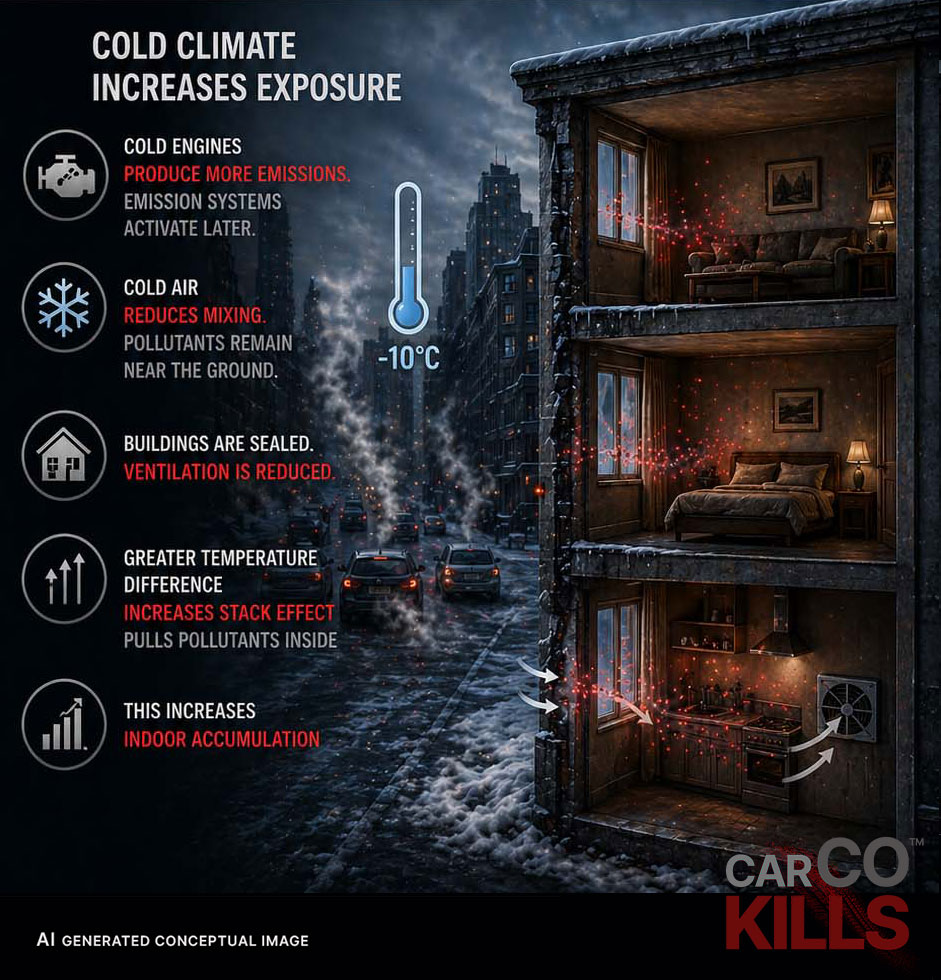
Cold Weather Pulls Outdoor Air Indoors
Thermal Pressure Forces
Cold climates alter the physical behavior of buildings. When indoor air is warm and outdoor air is cold, the temperature contrast creates powerful pressure forces known as the stack effect. Warm air naturally rises and escapes through the upper parts of the building structure, which creates a strong negative pressure zone lower in the structure.
The Infiltration Effect
Cold outdoor air is aggressively pulled inward. Air forces its way through structural leaks, material gaps, doors, vents, and mechanical intakes. Outdoor traffic pollution is transformed directly into indoor pollution.
The colder it is outside, the stronger this pressure-driven pull becomes, creating a dangerous environmental combination: higher exhaust volume outside coupled with stronger physical forces pulling that polluted air indoors.

Cold Air Traps Pollution Near the Ground
Winter Dispersion Failures
Winter weather conditions actively reduce the atmospheric dispersion of gases. Under stable winter weather profiles, vertical air mixing weakens. Cooler, denser air remains trapped near the ground while warmer air sits directly above it, acting like a structural lid over the city.
The Street-Level Trap
Exhaust gases cannot rise or escape efficiently. Vehicle pollution remains concentrated at street level and within the human breathing zone. Pedestrians and nearby buildings are exposed to highly concentrated air.
Cold air provides no guarantee of clean air; if environmental airflow is weak, highly polluted air remains locked in place.
High-Risk Overlap Zones
Where Cold-Climate Factors Converge
These cumulative environmental effects become most dangerous where tailpipe emissions occur close to building envelopes and localized airflow is restricted. High-risk overlap zones include:
- Parking areas and vehicle idling zones.
- Garages and subterranean garage exits.
- Courtyards and sheltered building corners.
- Building entrances and street canyons.
- Ventilation intake vents positioned near traffic lanes.
The Combined Winter Exposure Mechanism
A Multi-Layered Environmental Trap
Cold climate intensifies exposure because multiple structural and environmental mechanisms occur at the exact same time:
Step 1: Vehicles emit drastically more pollutants due to cold-start inefficiencies. Step 2: Emission control systems work less effectively or freeze entirely during warm-up. Step 3: Polluted air is trapped near the ground and disperses poorly due to stable cold air layering. Step 4: Temperature differences create negative pressure, pulling outdoor air into buildings. Step 5: Indoor windows stay closed for warmth, trapping the infiltrated pollution inside.
More pollution outside + less atmospheric dispersion + stronger indoor structural pull = a significantly higher exposure risk.
Bottom Line
The Chronic Research Blindspot: While air pollution is proven to drive cardiovascular, respiratory, and metabolic disease risk, the complete systemic loop of cold-weather ingress and chronic cellular stress remains a neglected research gap.
The Cold Emissions Spike: Vehicle emission controls take a long time to warm up and can fail entirely below −11 °C, causing real-world winter emissions to be drastically underestimated by standard tests.
The Structural Vacuum: Cold outdoor temperatures trigger a negative pressure effect in warm buildings, aggressively sucking outdoor exhaust through gaps, vents, and doors.
Atmospheric Inversion: Cold air layers create an environmental lid that stops vehicle exhaust from rising, trapping highly concentrated pollution at street level.
The Overlap Zones: Courtyards, building entrances, and ventilation intakes near parking areas create a perfect storm where high cold-start emissions and indoor suction converge.
The Invisible Systemic Burden: The dangerous reality of winter exposure is the combination of more pollution, zero dispersion, and continuous indoor infiltration where people spend most of their time.
Sources
Hu, J., et al. (2023). Contribution of cold starts to real-world trip emissions for light-duty gasoline vehicles. Atmosphere, 14(1), 35. https://www.mdpi.com/2073-4433/14/1/35
Wine, O., et al. (2022). Cold climate impact on air-pollution-related health outcomes. International Journal of Environmental Research and Public Health. https://pmc.ncbi.nlm.nih.gov/articles/PMC8835073/
Weilenmann, M., et al. (2009). Cold-start emissions of modern passenger cars at different ambient temperatures. Atmospheric Environment. https://www.sciencedirect.com/science/article/abs/pii/S1352231009001174
European Environment Agency. (2016). Temperature inversion traps pollution at ground level. https://www.eea.europa.eu/en/analysis/maps-and-charts/temperature-inversion-traps-pollution-at
U.S. Environmental Protection Agency. (n.d.). Introduction to indoor air quality and infiltration. https://www.epa.gov/indoor-air-quality-iaq/introduction-indoor-air-quality
Shrestha, P. M., et al. (2019). Impact of outdoor air pollution on indoor air quality in low-income homes. Indoor Air. https://pmc.ncbi.nlm.nih.gov/articles/PMC6801919/

site updates
The site is continuously updated.
Sources are under review, content will be added to existing topics, and more images will be brought to the site later.
NEW CONTENT COMING:
- News
– Rights to clean air